A Three-Year-Old Company Reselling Token Could Be Sold for $10 Billion
TL;DR
Stripe is reportedly discussing an OpenRouter acquisition at a valuation close to $10 billion. The article examines OpenRouter's AI routing model, growth and funding, Stripe's move from payments into AI infrastructure, and the AI Gateway landscape in China and overseas.
Whoever controls the routing layer for AI models controls the first toll gate of the intelligent economy.
Payment giant Stripe has reportedly entered talks to acquire AI model aggregation platform OpenRouter, with the deal potentially valuing the company at close to $10 billion, or roughly RMB 67.6 billion.
That figure would mean OpenRouter's valuation has climbed nearly sevenfold in just two months from the $1.3 billion valuation attached to its Series B round in May.
Stripe is willing to consider such a high price because it sees more than a fast-growing platform with about $140 million in annualized revenue and a gross margin close to 70%. It also sees an entry ticket to the infrastructure that collects fees across the intelligent economy.
OpenRouter has more than 8 million developer users and processes over 200 trillion Token each month, making it one of the default gateways through which AI applications access models worldwide.
Bringing it under Stripe would allow the payments company to connect the full value chain from online commerce payments to AI model calls. Every Token transaction and every agent decision could potentially flow through Stripe's infrastructure.

OpenRouter: The AI “Toll Collector” That Rose From the Ruins of NFTs
In 2023, while the global technology industry was still reacting to the arrival of ChatGPT, a startup called OpenRouter was quietly founded in New York.
Its founder, Alex Atallah, had just completed a turbulent entrepreneurial chapter. As co-founder and CTO of OpenSea, the world's largest NFT marketplace, he left the company in 2022 before the NFT bubble collapsed.

Alex Atallah
Atallah quickly turned his attention to the rapidly expanding AI market. In 2023, he co-founded OpenRouter with Louis Vichy.
Vichy is also a serial entrepreneur who has long focused on developer tools and platform-layer products.
OpenRouter is no longer merely an API relay. It has become core middleware for the AI era: an AI Gateway. It connects hundreds of foundation models below with large numbers of applications and agents above, handling critical functions including traffic routing, cost reduction, failover, security governance, and unified billing.
With one account and one API, developers can access OpenAI's GPT family, Anthropic's Claude family, Google's Gemini, and more than 400 open and closed models including DeepSeek and Kimi.
The platform connects more than 70 model and inference providers behind the scenes.
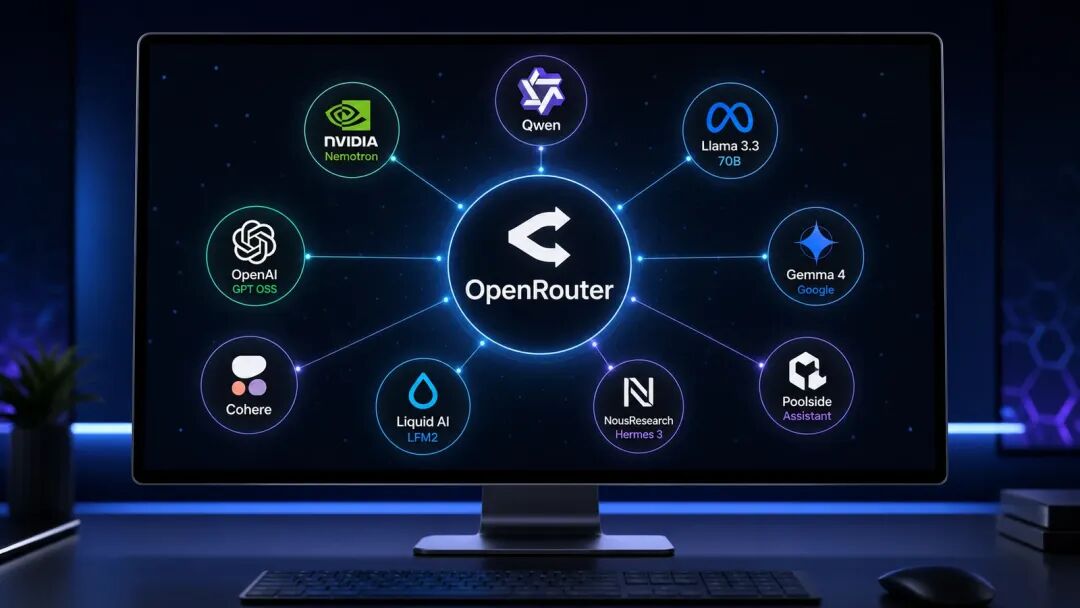
Its operating mechanism is an intelligent routing black box.
When a developer sends a request, the platform evaluates task type, cost, performance, and other predefined rules in real time, then automatically chooses the most suitable model and provider. If a model service goes down or rate-limits traffic, the request is automatically redirected to a backup provider. OpenRouter charges a platform fee of about 5% to 5.5%.
The value of this business model is that it addresses the central pain points developers face in a multi-model world: registering separate accounts, storing multiple API keys, managing different prices and billing methods, adapting to interface changes, and handling model outages.
Technology and traffic alone, however, are not enough to create a durable moat. At the model-routing layer, trust is the most expensive currency.
OpenRouter therefore promises not to retain data or use it for model training, treating trust as an invisible competitive barrier.
This strict commitment to data sovereignty and privacy has made it a neutral gateway through which enterprises are willing to route core workloads in multi-model deployments.
The business of charging a toll on model traffic has grown at an extraordinary pace.
In October 2024, OpenRouter's annualized revenue was about $10 million. By April 2026, it had risen to more than $50 million. By July, according to The Information, annualized revenue had increased further to approximately $140 million.
The number of Token processed each week rose from 5 trillion six months earlier to 25 trillion, a fourfold increase. The platform now has more than 8 million users and processes over 200 trillion Token each month.
More notably, the cost of providing its model-routing product accounts for only 28.5% of revenue. That implies annualized gross profit of about $100 million and a gross margin close to 70%, comparable to a high-performing listed software company.
In June 2025, OpenRouter completed a combined $40 million seed and Series A financing led by a16z and Menlo Ventures, with participation from Sequoia Capital and others. Its post-money valuation was approximately $547 million.
In May 2026, OpenRouter announced a $113 million Series B led by CapitalG, Alphabet's independent growth fund. NVentures, ServiceNow Ventures, MongoDB Ventures, Snowflake Ventures, and Databricks Ventures participated, while existing investors a16z and Menlo Ventures increased their commitments. The post-money valuation reached $1.3 billion.
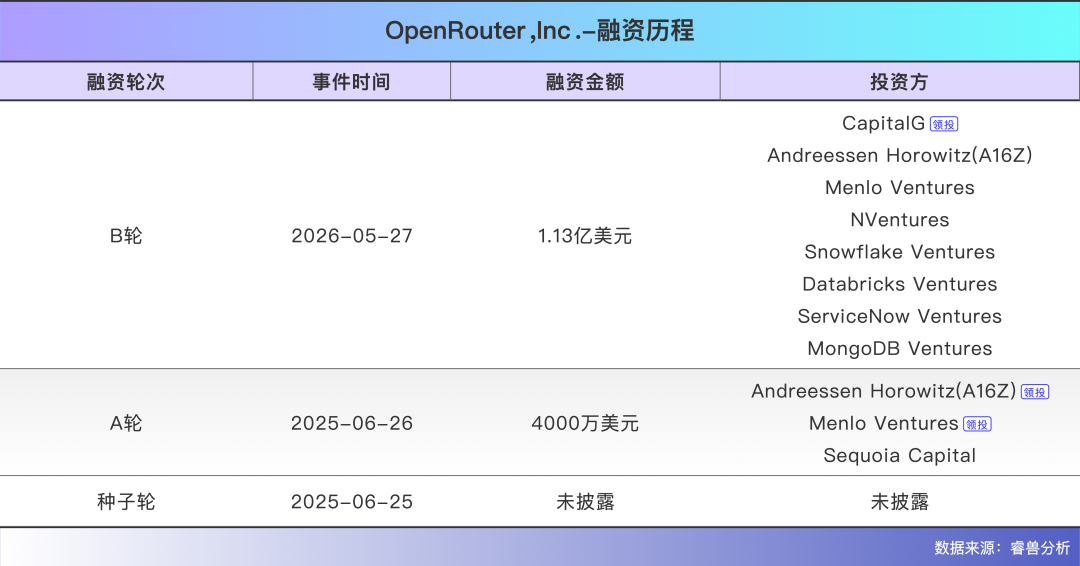
The real surge came after the Series B. Only two months later, Stripe's acquisition talks pushed OpenRouter's potential valuation toward $10 billion. With more than $150 million raised across three rounds, the three-year-old company went from a valuation of about $500 million to $10 billion in less than 14 months.

Stripe: The Ambitious Player Moving From Payment Rails to AI Infrastructure
Founded in 2010, Stripe is one of the world's leading providers of payment infrastructure.
Through a set of APIs, it helps companies integrate online payment processing, subscription management, business lending, automated tax calculation, and other services.

Stripe now supports more than 5 million businesses directly or through platforms. Its customers include every leading AI company, 90% of the companies in the Dow Jones Industrial Average, and 80% of those in the Nasdaq 100.
In 2025, businesses built on Stripe generated $1.9 trillion in total payment volume, up 34% year over year and equal to about 1.6% of global GDP. Stripe was valued at approximately $159 billion and held $3.2 billion in cash reserves.
An OpenRouter acquisition would not be an unrelated diversification move for Stripe.
The two companies have strikingly similar business models. Stripe allows internet companies to accept payments through one interface instead of separately connecting to banks, card networks, and payment methods in different countries. OpenRouter lets developers call models through one interface instead of integrating separately with every AI provider.
At a deeper level, the ceiling of the payments business is visible: Stripe's revenue fundamentally comes from taking a small fee from each transaction.
The AI Token business is different. Token are the new payment unit of the AI era. Extending from payment fees to fees on Token calls is essentially the same business model applied to a new underlying asset.
Stripe has long been tied to the AI industry. In 2023, OpenAI selected Stripe to process ChatGPT Plus subscriptions. Today, every company on the Forbes AI 50 list that accepts online payments runs on Stripe, and Anthropic, Midjourney, and Cohere are also customers.

At Stripe Sessions in April this year, the company released 288 products and updates, with themes centered overwhelmingly on building economic infrastructure for AI.
While negotiating to acquire OpenRouter, Stripe also joined private-equity giant Advent International in making an offer of more than $53 billion for established payments company PayPal.

The strategic logic is similarly clear. Stripe's business is concentrated on merchants, while PayPal has more than 430 million consumer accounts and direct consumer-payment and banking relationships. A combination would give Stripe Venmo's peer-to-peer network and PayPal's consumer checkout button, while routing more transactions through its own network and reducing reliance on card networks such as Visa and Mastercard. This could also support Stripe's stablecoin ambitions by providing a large consumer distribution network.
From human payments to machine and agent payments, and from business merchants to consumers, Stripe is building a strategy that spans traditional payments and AI infrastructure. OpenRouter is one of the most important pieces on that board.

Why Is It Difficult for China to Produce an “OpenRouter”?
OpenRouter is not the only company in AI routing. A growing AI Gateway ecosystem is taking shape.
Open-source alternatives are a major force in overseas markets.
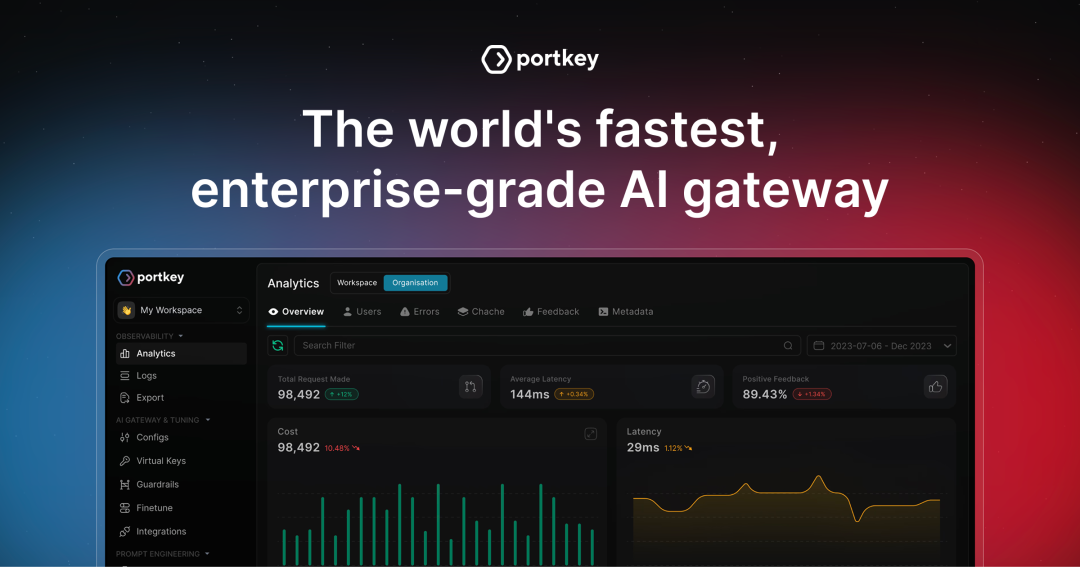
Portkey focuses on enterprise governance and security management. Through a unified interface, it can connect to more than 1,600 models across language, vision, audio, and other modalities. Built-in guardrails, cost tracking, and intelligent routing help enterprises control AI spending and risk. It has managed more than $180 million in AI expenditure. Portkey has now been acquired by cybersecurity giant Palo Alto Networks and integrated into its AI security platform.
LiteLLM is one of the most widely used open-source AI Gateway projects and is officially recommended by AWS as a leading option for self-hosted deployment. It provides a unified OpenAI-compatible API, supports more than 100 LLM providers and over 2,500 models, and is lightweight and fast. Companies including Netflix have adopted it.
One API is explicitly described by its community as an open-source alternative to OpenRouter. Written in Go, it is an API management and distribution system designed for developers who want to operate their own Token relay. It supports chat, image generation, speech, embeddings, and other modalities, covers about 28 model providers including OpenAI, Anthropic, DeepSeek, and Zhipu GLM, and automatically converts between different API formats.
The Chinese market is split between two types of participant.
Cloud platforms led by Baidu Qianfan, Alibaba Bailian, and Volcano Engine treat model aggregation as an extension of their MaaS ecosystems. Qianfan aggregates more than 150 models and serves 460,000 enterprises; Bailian connects more than 200 models and reaches 5 million users worldwide; Volcano Engine offers Agent packages and integrates more than 80 models.
Their commercial loop is based on bundling model calls with cloud infrastructure such as compute and storage. In essence, the platform is the ecosystem rather than an independent middleware layer.
Independent startups, meanwhile, are splitting into two extremes. SiliconFlow positions itself as an independent Token supply platform. It supports 170 models, handles nearly 600 billion Token per day, has more than 10 million registered users, and is pursuing a Hong Kong listing as the first public “AI Token factory.” Its RMB 200 million in research and development spending, however, reflects a capital-intensive model.
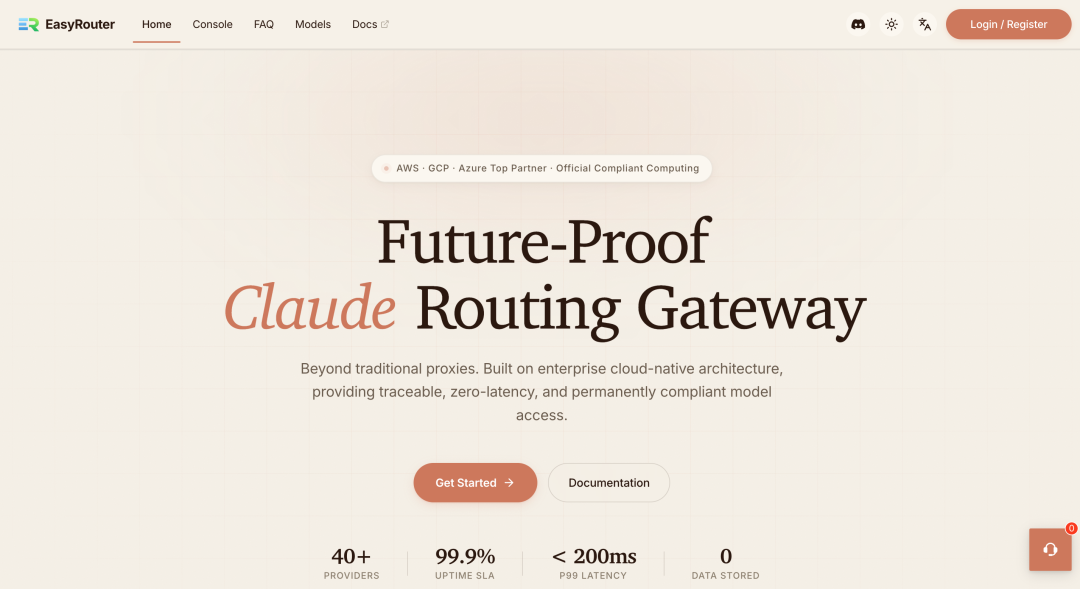
In May 2026, Cheetah Mobile CEO Fu Sheng announced EasyRouter, which offers a unified interface for more than 40 mainstream models including GPT, Claude, Gemini, and DeepSeek, and uses discounts and reward points to attract users.
At almost the same time, NetEase Youdao officially launched ThinkFlow, an enterprise large-model aggregation platform that uses standardized APIs to bring more than 20 mainstream models, including DeepSeek, Kimi, and Qwen, under unified routing.

EasyRouter and ThinkFlow are lighter products. They include intelligent routing and circuit breakers, emphasize millisecond-level failover and end-to-end cost visibility, and are typical AI relay platforms.
Although China's capital market and entrepreneurs are enthusiastic about the OpenRouter model, the commercial story of a Chinese OpenRouter is far less straightforward than it is overseas.
The first obstacle is model accessibility. OpenRouter's core value comes from aggregating the world's strongest models. Yet leading overseas models place barriers on registration, payment, and access for users in mainland China. Domestic AI aggregation platforms therefore begin with a less complete model catalog.
A deeper challenge is regulation and compliance. AI relay platforms are an emerging business category without a clearly defined regulatory framework, and the boundary between acceptable and prohibited activity is often unclear.
The sustainability of the business model also faces challenges in China. OpenRouter's valuation rests on a global market with many competing model suppliers: the more numerous and fragmented the models, the more valuable the routing layer becomes. China's AI model market is more concentrated, with a small number of leading providers controlling most of the market. When developers can obtain model services directly from a few large companies, the middle layer has less bargaining power and a weaker reason to exist.
The rise of the AI routing layer reveals a simple commercial truth: in any technological revolution, the most durable profits often lie not in creating value but in distributing it.
Foundation-model companies are spending heavily to train ever-larger models, while application developers struggle to find viable use cases.
When Token replace money as the medium of exchange and agents replace humans as the principal actors in transactions, whoever controls the pipelines through which Token flow will control the lifeblood of the next commercial civilization.

Editorial team
Product Team @ WebCal
The official product team behind WebCal. We build high-performance computing infrastructure and decentralized cloud solutions.